
INTUMESCENT COATING THICKNESS: WHY IT MATTERS
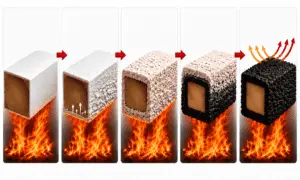
The thicknesses of intumescent coatings will vary depending on the material or assembly to be fire-rated and the specific fire rating required.
A fire-resistance rating cannot be determined based on the performance of a single material. Rather, it is the cumulative contribution of all assembly components, including, for example:
Steel – wood – gypsum board – plaster – concrete – fiberglass/plastic – mineral wool insulation.
Steel
This material is widely used in building construction for structural beams, columns, galvanized steel panels, steel framing, metal roofs, steel decking, wall panels, and other structural and non-structural components.
Although structural steel generally begins to lose significant strength as its temperature approaches 593°C / 1,100°F (note: different beam and column sizes have different individual failure rates in a fire), the fire performance of an individual steel member is not measured by temperature alone. The time required to reach a critical condition during a fire varies depending on size, shape, mass, section factor, and applied loads. The required dry film thickness of the coating will also vary from one beam or column to another.
The same principle applies to metal walls, steel framing, metal wall and roof panels, steel decking, and other building components.
Wood
This substrate also has different fire-resistance performance depending on the type of material, member size, and intended application within the assembly. Solid timber, heavy timber, engineered wood products (OSB, LSL and PSL, and I-joists), and structural wood panels each have distinct fire-performance characteristics that must be considered when evaluating the fire value of a building assembly.
As an example, solid timber wood joists, OSB-webbed I-joists, and wood web trusses held together with metal pressure plates all have different fire-performance times.
The same holds true for gypsum board, plaster, concrete, fiberglass, plastic, and foam, further detailing the importance of being aware of exactly what intumescent coating thickness must be applied.
One Coating Thickness Does Not Fit All
Some manufacturers of intumescent coatings publish a single, very thin coating thickness that is represented as being suitable for a wide range of substrates and construction assemblies.
Such claims should be carefully evaluated, as the required thickness of a fire-resistant coating depends upon the specific material, assembly configuration, and the fire test or fire-engineering evaluation supporting the claimed performance.
Specifiers, code officials, and architects should verify that any published fire-performance claims are supported by fire testing conducted by qualified fire laboratories accredited through IAS or another recognized accreditation body, and that the reported results are applicable to the specific material or assembly under review.
The Firefree Approach
Before specifying Firefree 88®, Firefree Class A, or the Firefree Exterior System, our Technical Team carefully reviews information about your specific project, including the assembly details, substrate, dimensions of structural members, and required fire rating.
Only after reviewing this information will the Technical Team identify the correct coating thickness for your project and assembly, supported by the necessary fire-testing data.
There is no single coating thickness suitable for every assembly or project. Please carefully evaluate the products you select and use reliable, tested, and certified fire-protection systems to help ensure effective protection in the event of a fire.