
Fire performance is not something you leave to interpretation on a project set. As an architect or engineer, you already know that once materials go into a building, their behavior under fire exposure becomes a code, liability, and life-safety issue. This is where ASTM E84 is considered a baseline reference across U.S. fire safety standards.
In real project terms, ASTM E84 is what you look at when you need clear numbers, not assumptions. In this blog, we break down what ASTM E84 is, how the test works, and why it plays a critical role in evaluating fire performance. We’ll also look at its code implications, material classifications, and what you should focus on when reviewing test reports for real-world project applications.
What Is ASTM E84?
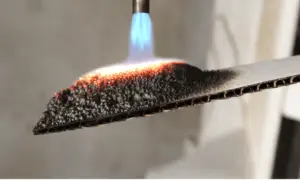
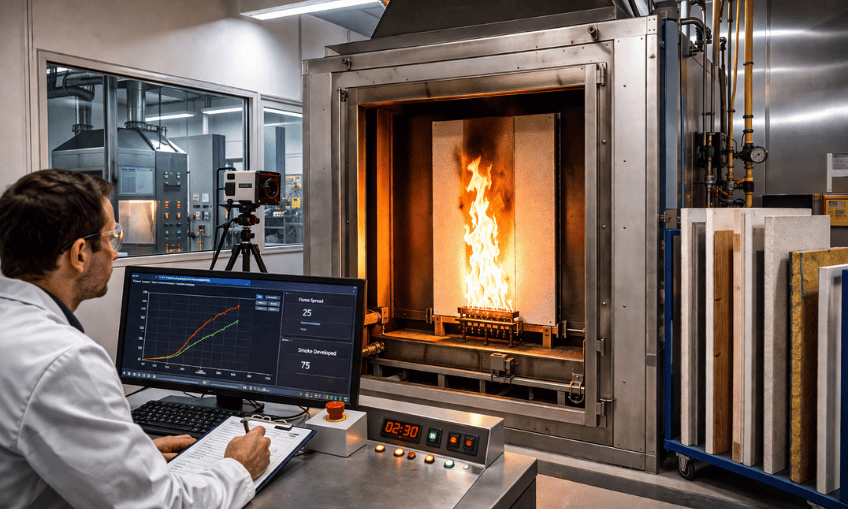
The ASTM E84 test method provides data on surface burning characteristics, specifically the flame spread index and smoke developed index. These values are crucial for material submittals, specifications, and AHJ approvals. The test itself is conducted in the Steiner Tunnel Test, a long horizontal chamber where the material is installed in a ceiling position.
Once exposed to a calibrated flame source, the system tracks flame travel and smoke generation in real time. The system outputs the flame spread index and smoke developed index, deriving both by comparison to standard reference materials. You will often see ASTM E84, NFPA 255, and UL 723 used interchangeably in specifications.
Also Read: ASTM E84 Explained for Architects and Builders
What Are the ASTM E84 Certification Requirements?
When you work through code requirements on a project, ASTM E84 does not appear in just one place. It shows up across different sections of the International Building Code depending on how and where the material is used. For exterior wall systems under Chapter 14, compliance ties back to Section 1703.5, where proper labeling and third-party verification become part of the approval process.
For materials such as fire-retardant-treated wood and foam plastics, the requirements are more defined. Chapters 23 and 26 call for certification from an approved agency. In these cases, running the ASTM E84 test method alone is not sufficient. The material must consistently show surface burning characteristics, including flame spread index and smoke developed index.
Interior finishes of the construction project follow a different path. The code requires testing in accordance with ASTM E84, but it does not explicitly require certification. Even so, many manufacturers choose to certify their products.
From a design and review standpoint, this makes a difference. When a product comes with a verified building materials fire rating, such as ASTM E84 Class A, it reduces questions during submittals and helps avoid delays during approvals.
Which Building Materials Require ASTM E84 Testing?
ASTM E84 applies to a wide range of building materials and finish systems. The method supports evaluation across both structural and non-structural components, provided they present an exposed surface condition. Common product categories include:
- Wallcoverings and decorative finishes
- Insulation systems, including duct and pipe insulation
- Panel products and composite assemblies
- Paints, coatings, and adhesives
- Sealants and joint compounds
- Ceiling tiles and acoustic panels
- Wood products, including dimensional lumber and veneers
- Plastics and composite materials
- Reflective insulation and radiant barriers
Each category may require specific specimen preparation procedures to ensure representative performance during testing.
Flame Spread Index and Smoke Developed Index
ASTM E84 generates two primary indices that define material performance:
- Flame Spread Index (FSI): Quantifies the rate at which flame advances across the material surface.
- Smoke Developed Index (SDI): Measures smoke generation relative to standard calibration materials.
Both indices are derived from comparative analysis against reference materials such as red oak and inorganic cement board. We round values to standardized increments for consistency:
- FSI rounds to the nearest multiple of 5
- SDI rounds to the nearest multiple of 5 below 200, and to 50 above 200
These indices form the basis for classifying materials within building codes.
What Are the Different Classes for ASTM E84?
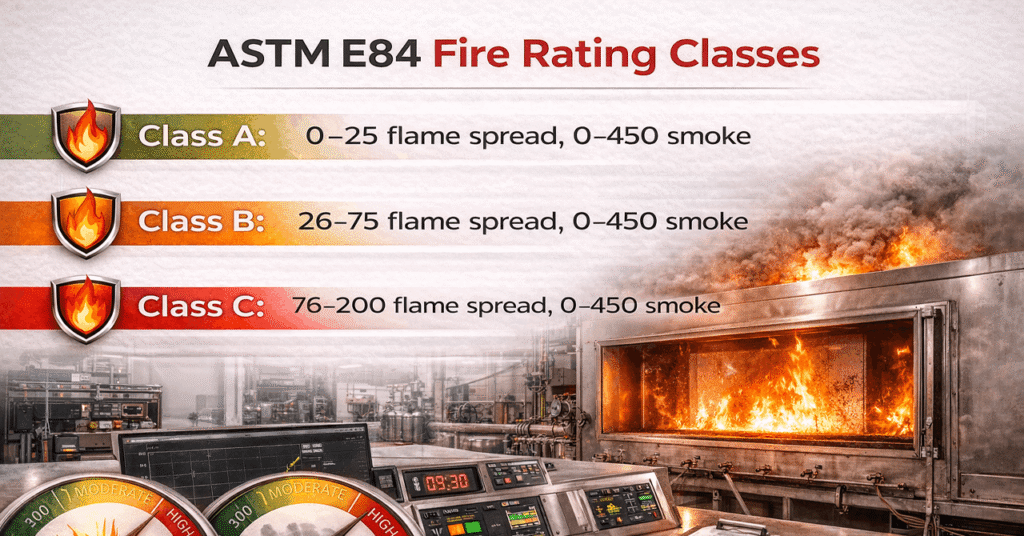
Building codes categorize materials based on ASTM E84 results into three primary classes:
| Class | Flame Spread Index | Smoke Developed Index |
| ASTM E84 Class A | 0-25 | 0-450 |
| Class B | 26-75 | 0-450 |
| Class C | 76-200 | 0-450 |
What Are the Results from ASTM E84 Reports?
Beyond FSI and SDI values, an ASTM E84 report offers a comprehensive dataset, including:
- Time to ignition
- Flame spread distance over time
- Maximum flame travel distance
- Temperature profile throughout the test
- Time to peak temperature
- Smoke generation trends over time
These data points support deeper analysis for engineers who require performance insights beyond classification.
ASTM E84 and Its Role in Fire Safety Compliance
ASTM E84 gives architects and engineers a clear and dependable way to understand how building materials behave in a fire. Instead of relying on guesswork, it provides real data on flame spread and smoke, helping teams meet codes, improve safety, and move projects forward with fewer delays and uncertainties.
At Firefree Coatings, our products are a preferred choice for architects, backed by ASTM E84 testing that provides clear data on flame spread and smoke development. Our products are tested by accredited third-party laboratories to ensure consistent fire safety performance for your projects and clients.