
Wildfires are no longer rare events that only affect remote areas. Today, millions of homes sit in areas where development meets natural vegetation. In fact, according to the ICC (International Code Council), more than 46 million homes and 70,000 communities across the United States are now located in the wildland-urban interface zones. This reality has changed how buildings are designed, especially for exterior walls.
When it comes to WUI exterior wall requirements, the goal is to protect your home from wildfires. Walls must resist ignition, slow fire spread, and prevent embers from entering the structure. They are now part of modern code requirements and a broader system of construction standards to improve survival during wildfire exposure.
What Is the Wildland-Urban Interface?
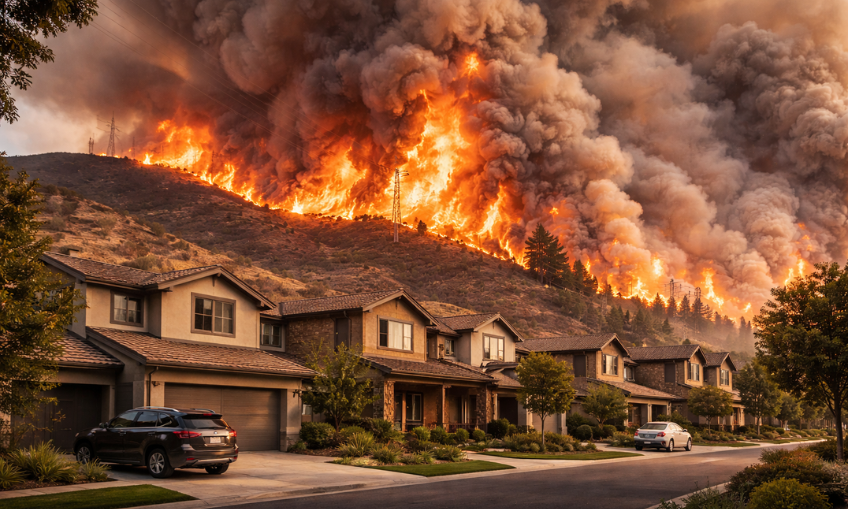
The wildland-urban interface refers to areas where buildings and natural vegetation exist side by side. These locations face a unique fire risk because structures are exposed to:
- Direct flame contact
- Radiant heat
- Wind-driven embers
Because fire can attack from multiple paths at once, wildland-urban interface building codes are written to address the entire building envelope. Exterior walls are a critical part of that system simply because they cover most of the structure’s surface.
Which Materials Meet WUI Compliant Siding Requirements?
WUI-compliant siding materials for walls are selected based on how they react to heat and flame. The biggest concern is not just direct fire, but embers that can lodge against the wall and ignite it over time.
Materials such as fiber cement, stucco, and masonry perform well because they do not ignite easily and can withstand prolonged heat exposure. This is one of the basic WUI exterior wall requirements, as outlined in codes like IWUIC and California Chapter 7A.
What Are the California Chapter 7A Wall Requirements?
These wildland-urban interface building codes focus heavily on preventing flame penetration and ember intrusion. That’s where ASTM testing standards come in.
- ASTM E84 evaluates flame spread and smoke development across a material’s surface. Lower flame spread values indicate better performance for exterior walls.
- ASTM E119 tests full wall assemblies. It measures how long a wall can resist fire while maintaining structural strength and limiting heat transfer. This is the basis for a one-hour fire-rated exterior wall assembly.
- ASTM E2910 is widely used for California Chapter 7A wall requirements. It exposes wall assemblies to both flames and burning embers, closely reflecting real wildfire conditions.
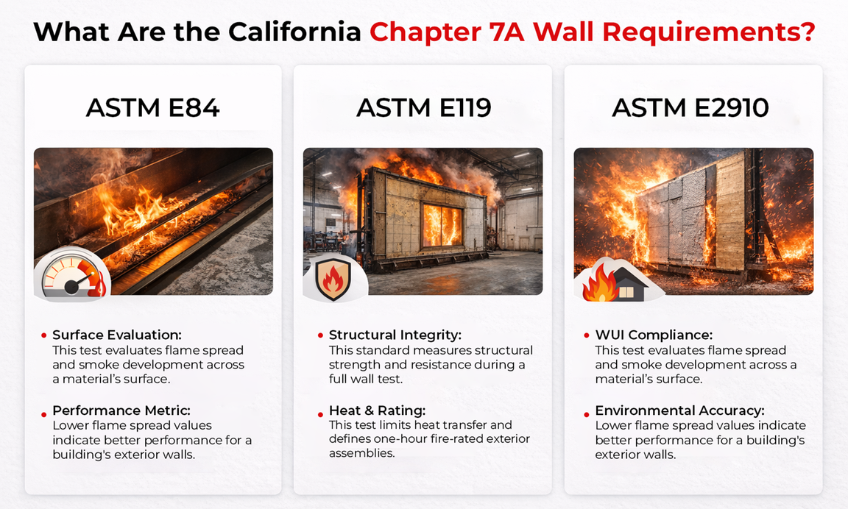
Note: These tests focus on how complete wall systems perform, not just individual materials.
IWUIC Exterior Wall Construction Standards
These standards set the foundation for WUI compliance across many regions in the United States. In high-hazard areas, buildings are generally required to meet Class 1 ignition-resistant construction. For exterior walls, this means:
- A minimum one-hour fire-resistance rating or noncombustible materials.
- Continuous protection from the base of the wall to the roofline
- Integration with other fire-resistant components like eaves and projections
WUI Wall Codes & Standards Requirements
Here’s a quick overview of the main codes and standards that apply to WUI exterior wall construction:
| Code / Standard | Purpose | What It Covers |
| IWUIC Exterior Wall Construction Standards | Base WUI code | Requires ignition-resistant construction in wildfire-prone areas |
| California Chapter 7A | State-specific WUI code | Strict rules to prevent ember intrusion and flame penetration |
| ASTM E84 | Material surface test | Measures flame spread and smoke development |
| ASTM E119 | Wall assembly test | Evaluates fire-resistance rating (e.g., 1-hour wall) |
| ASTM E2910 | WUI fire exposure test | Simulates wildfire conditions (flames + embers on walls) |
Do Fire-Resistant Coatings Help with Your Wall’s WUI Compliance?
Fire-resistant coatings and paints are often used as an added layer of protection, but they are not a substitute for compliant construction. Their role is limited but useful:
- They can slow down ignition
- They can reduce surface flame spread
- They can improve the performance of existing wall systems
In retrofit situations, they offer a practical way to enhance fire resistance without replacing the entire wall assembly. However, they are most effective when applied over materials that already meet WUI exterior wall requirements.
Build Walls That Stand Up to Wildfire, Start Protecting Your Structure Today
WUI exterior wall requirements focus on how a wall performs during a wildfire. It must resist ignition, limit flame spread, and keep embers out. This depends on the full wall assembly, not just the surface material. Fire-resistant coatings can also help significantly, but they do not replace proper construction.
At Firefree Coatings, Firefree 88® is a nontoxic, water-based coating for walls. It has a smooth, matte finish and strong adhesion. It is compliant with ASTM E84 and ASTM E119 and offers a two-hour fire rating. It works on concrete, masonry, and composite materials. Strengthen your walls with our advanced fire-resistant coatings.