
Fire safety is essential across residential, commercial, and industrial spaces. With rising wildfire activity, expanding cities, and aging infrastructure, fire risks are becoming more common. This is why selecting the right intumescent retardant paint and resistant coatings is very important. Firefree Coatings offers advanced fire protection products designed to meet different needs.
We offer three products, including Firefree 88, Firefree Class A, and the Firefree Exterior System, to better protect your property from fire. Each of our advanced products serves a unique purpose and is made for specific surfaces and environments. In this blog, we will discuss the major differences between these products, along with their benefits and compliance requirements.
Why Our Intumescent Retardant Paint and Fire-Resistant Coatings Matter?
Our products provide an additional layer of safety for buildings. They do not replace building codes or safety systems. Instead, they support them. These paints and coatings slow the spread of flames and help protect structural materials. This additional time can significantly improve evacuation safety and emergency response. It can help people exit safely and reduce damage.
Modern buildings use a range of materials. Many of them can catch fire quickly if left unprotected. Our products are designed to reduce this risk. They are tested under strict standards and used in many industries. From homes to commercial buildings, these coatings help improve safety without altering the space’s appearance.
Firefree 88: Fire-Resistant Coating
Firefree 88 is a fire-resistant coating designed for a wide range of surfaces. It is a water-based, thin-film coating that forms a protective layer when exposed to fire. This layer helps shield building materials and slows the progress of flames.
As a 2-hour-rated intumescent paint, this product can be applied to wood, concrete, masonry, aluminum, galvanized steel, spray polyurethane foam (SPF), and more. Ff88 can be applied using an airless sprayer, which is the preferred method. It can also be applied with a brush or a roller. No thinning is needed.
During application, the wet layer should be checked with a wet film gauge to ensure the correct thickness is achieved after drying. If more than one coat is needed, allow each coating to dry completely before applying the next. This flexibility makes it suitable for a wide range of applications.
One of Ff88’s main strengths is its ability to meet strict fire safety standards. It has been tested under many international codes. These tests assess how well the coating protects a building’s structural components over time. Ff88 is also known for being low in odor and low in volatile organic compounds (<36 g/L).
Certifications and Test Standards
- Fire Resistance Testing:
- ASTM E-119
- CAN/ULC-S101
- Room Fire Growth Testing
- UBC 8-2 and NFPA 286
- International Standards
- AS 1530.4 (Australia)
- EN 13501-1 (Europe)
- Smoke and Toxicity Testing:
- ASTM E 662-97
- BSS-7239-88 (Boeing Test)
Firefree Class A (Fire Retardant Paint for Wood)
Firefree Class A is a fire-retardant paint mainly designed for wood and other combustible materials. It has been tested to ASTM E84 and achieved a Class A rating. This rating measures flame spread and smoke development. FfA is often used in areas where wood is exposed and requires additional protection. It helps slow the rate at which flames spread across the surface.
FfA is simple to apply and works well with standard brushes, rollers, and spray equipment. The application process is easy and fits into both new construction and renovation schedules, helping to avoid project delays. This fire-retardant paint for wood works well in homes, apartment buildings, commercial spaces, and industrial facilities, making it an ideal choice for many types of projects.
Test Performance and Fire Ratings
Firefree Class A has been tested at QAI Laboratories, an IAS-recognized and CALFIRE-approved fire testing facility.
ASTM E84 Testing (10-Minute Test):
- Flame Spread Index (FSI):
- 25 at 6 mils thickness
- 0 at 10 mils thickness
- Smoke Developed Index (SDI):
- 30, meeting air plenum space requirements
- Under extended testing using ASTM E84, Firefree Class A achieved:
- Flame Spread Index of zero
- Smoke-Developed Index of zero
Firefree Exterior System for Wildfire
The Firefree Exterior System is a two-step coating system designed for buildings in wildfire-prone areas. It complies with ASTM fire and weather standards and meets the California Building Code Section 704 A requirements. This system includes two parts:
- Firefree Class A as the base layer
- Applied in two coats
- 10 mils dry thickness of each coat
- Total thickness of 20 mils
- Coverage of approximately 53 square feet per gallon
- Firefree Exterior Topcoat as the protective finish
- Applied in two coats
- 3 mils dry thickness of each coat
- Total thickness of 6 mils
- Coverage of approximately 110 square feet per gallon
The first layer helps reduce the risk of surface ignition. The topcoat protects the base layer from outdoor conditions like rain, sun, and wind. Together, these layers create a long-lasting protective barrier for exterior surfaces. The effectiveness of the Firefree Exterior System depends on:
- Proper surface preparation
- Correct coating thickness
- Professional application
- Maintenance over time
- Actual wildfire conditions
For best results, follow all application guidelines closely and maintain the coatings regularly.
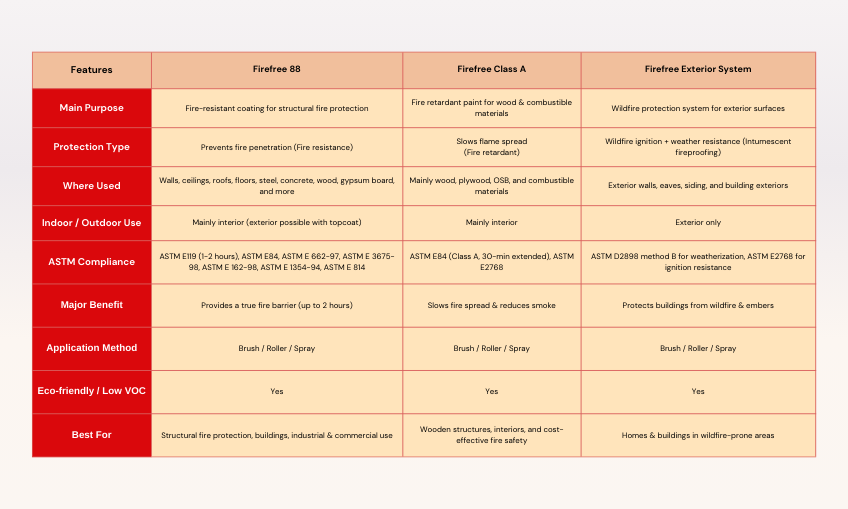
Differences Between Ff88, FfA, and Firefree Exterior System
| Features | Firefree 88 | Firefree Class A | Firefree Exterior System |
| Main Purpose | Fire-resistant coating for structural fire protection | Fire retardant paint for wood & combustible materials | Wildfire protection system for exterior surfaces |
| Protection Type | Prevents fire penetration (Fire resistance) | Slows flame spread(Fire retardant) | Wildfire ignition + weather resistance (Intumescent fireproofing) |
| Where Used | Walls, ceilings, roofs, floors, steel, concrete, wood, gypsum board, and more | Mainly wood, plywood, OSB, and combustible materials | Exterior walls, eaves, siding, and building exteriors |
| Indoor / Outdoor Use | Mainly interior (exterior possible with topcoat) | Mainly interior | Exterior only |
| ASTM Compliance | ASTM E119 (1-2 hours), ASTM E84, ASTM E 662-97, ASTM E 3675-98, ASTM E 162-98, ASTM E 1354-94, ASTM E 814 | ASTM E84 (Class A, 30-min extended), ASTM E2768 | ASTM D2898 method B for weatherization, ASTM E2768 for ignition resistance |
| Major Benefit | Provides a true fire barrier (up to 2 hours) | Slows fire spread & reduces smoke | Protects buildings from wildfire & embers |
| Application Method | Brush / Roller / Spray | Brush / Roller / Spray | Brush / Roller / Spray |
| Eco-friendly / Low VOC | Yes | Yes | Yes |
| Best For | Structural fire protection, buildings, industrial & commercial use | Wooden structures, interiors, and cost-effective fire safety | Homes & buildings in wildfire-prone areas |
How to Choose the Right Intumescent Retardant Paint and Fire-Resistant Coatings?
The correct choice depends on your project’s needs. This includes:
- If you are working on interior spaces that require high fire resistance, Ff88 is a strong option.
- If your project uses exposed wood and needs a Class A rating, FfA is an efficient choice. It helps meet code requirements without changing design plans.
- If your building is in a wildfire-prone area, the Firefree Exterior System offers targeted protection for outdoor surfaces.
Final Thoughts on the Differences Between Ff88, FfA, and Firefree Exterior System
Choose the right Firefree product based on your building’s materials, location, and safety needs. Firefree 88 provides strong fire resistance. Firefree Class A slows flame spread on wood. The Firefree Exterior System protects against wildfire risks. Together, these coatings enhance safety, minimize fire-related damage, and help meet building code requirements. They offer reliable, long-lasting protection for residential, commercial, and industrial spaces. Contact us today.