
Fire safety is something most people think about only after a close call. A small kitchen flame or a short circuit can turn into a big disaster within minutes. That is why more homeowners and builders are now paying attention to flame-retardant paint and how it can reduce fire risks in daily life. At the same time, many people confuse this solution with fully fireproof systems.
They are not the same. In reality, no material is completely fireproof. However, fire or flame-retardant paint can improve a material’s resistance to fire but does not make it fireproof. In this blog, we will explain how fire-retardant paint works, how it compares with fireproof materials, and what you should realistically expect from them.
What Is Fire-Retardant Paint?
Fire-retardant paint is a special coating designed to slow down the spread of flames. Most flame-retardant paint works in one of two ways. Some paints release water vapor or non-flammable gases when heated. This cools the surface and dilutes oxygen around the fire. Others swell and create a thick foam-like barrier called an intumescent layer.
This expanding layer acts like a thermal shield. It protects materials like wood, steel, and concrete from rapid heating. These paints do not completely stop fire. Instead, they buy crucial time for evacuation. That time often makes the difference between a small incident and a major tragedy.
How Is Flame-Retardant Paint Important for Fireproof Materials?
Fireproof materials are manufactured to withstand high temperatures without burning. Examples of such materials include concrete, brick, steel, gypsum boards, and certain treated composites. These materials are often used in the construction of structures. One common myth is that fireproof means fire can never cause damage.
As mentioned earlier, no material is completely fireproof. They only resist fire for a limited time. Even concrete can crack under extreme heat. Steel loses strength when temperatures rise. Flame-retardant paint helps delay this loss of strength in steel, reducing the risk of early structural failure and collapse.
Let’s understand this by another example. Imagine wooden stairs in a home. Wood catches fire easily. When coated with fire-retardant paint for wood, the surface becomes more resistant to flames. If a fire breaks out nearby, the paint slows down ignition, giving people extra time to escape and firefighters more time to respond.
So, when people call a material fireproof, they usually mean that it has been treated with fire-retardant paint to resist fire for a certain period. While these paints are helpful, they should be part of a broader fire safety plan that includes alarms, sprinklers, and safe exits.
Flame-Retardant Paint vs Fireproof Materials
| Feature | Flame-Retardant Paints | Fireproof Materials |
| Basic Purpose | Slows down fire spread and delays ignition | Resists fire for a longer time |
| Fire Resistance Level | Provides moderate protection and buys critical time to evacuate | High resistance, but not fully fireproof |
| Application | Applied as paint or coating | Built into the structure |
| Installation | Easy to apply to existing surfaces | Requires construction or major renovation |
| Cost | Lower cost and budget-friendly | Higher cost due to materials and labor |
| Maintenance | Very low maintenance | Higher maintenance |
| Weight Added | Minimal | Often heavy materials |
| Design Flexibility | Maintains original look | Limited design flexibility |
| Fire Protection Type | Passive fire delay | Passive fire resistance |
| Upgrade Option | Ideal for both new and retrofitting older buildings | Best for new construction |
How to Select Flame-Retardant Paint for Fireproof Materials?
Choosing the right flame-retardant paint goes beyond just checking the fire rating. It is about selecting a coating that fits your surface, your environment, and your safety needs. Here are the most important factors to consider.
ASTM E84 Tested Certification
Always choose flame-retardant paint that is ASTM E84 tested and approved. ASTM testing confirms how well the paint slows flame spread, reduces heat release, and controls smoke. This ensures the product performs reliably during real fire conditions and meets recognized safety standards.
Low VOC Formulation
Low-VOC paints help maintain healthy indoor air quality. VOC levels below 36 grams per liter reduce harmful fumes and make the environment safer for many properties. This is especially important in enclosed spaces and areas with daily human exposure.
Compatibility with Douglas Fir, OSB, and More
Not all paints bond well with wood products. Choose fire-retardant paint for wood that is approved for oriented strand board (OSB), Douglas fir, and plywood. This ensures strong adhesion, better protection, and long-lasting fire resistance.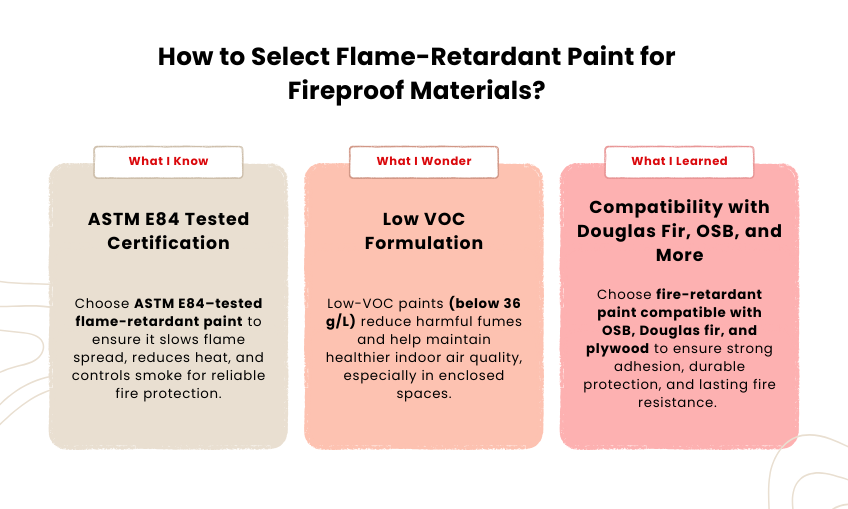
Final Thoughts on Flame-Retardant Paints Vs Fireproof Materials
Flame-retardant paints and fire-resistant materials work best together, not alone. These paints slow ignition, reduce heat impact, and buy important evacuation time, while fire-resistant materials maintain structural stability longer. At Firefree Coatings, our fire-retardant paint for wood, Firefree Class A, provides simple and reliable fire protection.
It is tested to ASTM E84 standards, including the 30-minute extended test. The paint is easy to apply, cost-effective, and safe for indoor use. It works on many combustible surfaces, slowing flame spread and giving people more time to escape safely. Contact us today!