
Wood remains a popular choice in contemporary architecture, appearing in projects from homes to commercial buildings. During material selection, architects often consider fire retardant paints for wood and look for verified fire ratings, code compliance, and long-term durability. They also review test data, certifications, and application requirements before approval.
These paints let architects stay creative without compromising safety. Proper coating selection helps meet fire performance goals without changing design intent. Architects can balance safety requirements with visual expectations in a practical way.
Why Fire Retardant Paint for Wood Is an Architect’s Top Choice
Materials that reliably meet code requirements are essential for architects. Fire retardant paint for wood meets that expectation when backed by verified test data. It allows architects to specify exposed wood without compromising fire safety objectives. These paints directly address surface-burning characteristics in key areas. Flame spread and smoke development influence how spaces perform during a fire event.
This is especially important in WUI zones. In these areas, ignition resistance requirements are governed by codes such as the International Wildland-Urban Interface Code (IWUIC) or by state-specific regulations, such as California Chapter 7A. These factors impact egress planning and occupant safety across different building types.
“Wood that wows, fire safety that counts”
What Code Standards Apply to Fire Retardant Paint for Wood in the U.S?
Before approval, architects check test data, certifications, and application guidelines. This step usually happens before engaging with a manufacturer or approving a product. Fire retardant paint for wood must meet clearly defined standards to be considered for real projects.
International Code Council and Building Code Alignment
Architects begin with the framework set by the International Code Council. The IBC and IRC establish baseline requirements for fire performance in buildings. Local Authorities Having Jurisdiction (AHJ) enforce these codes during plan review and inspections.
These paints must align with these codes through documented compliance. Architects look for ICC evaluation reports and ESR listings during this stage. These documents confirm whether the product meets code requirements under specific conditions.
Interior finish classification is governed by IBC Chapter 8. In this section, flame spread and smoke-developed indices determine whether a material is acceptable. In some cases, coatings are evaluated against fire-retardant-treated wood provisions. These provisions are defined under IBC Section 2303.2.
ASTM E84 Surface Burning Characteristics
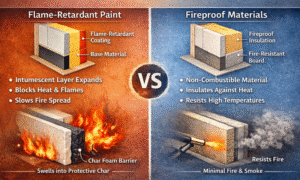
Coating systems applied to wood are evaluated using ASTM E84 (UL 723) to determine surface-burning characteristics. This test measures flame spread & smoke development on material surfaces. A Class A rating requires a flame spread index between 0 and 25 with smoke-developed index ≤450 per IBC.
These paints must produce consistent results in ASTM E84 testing. The standard test duration is generally 10 minutes. Extended-duration testing may also apply in some cases. Architects review both flame spread index and smoke-developed index values. These numbers directly influence whether a product can be specified for interior finishes.
ASTM E2768 Ignition Resistance for Exterior Applications
ASTM E2768 comes into focus for exterior wood applications. This standard evaluates ignition resistance under more severe fire exposure. It is commonly referenced in wildfire-prone regions.
These paints must meet the performance requirements of ASTM E2768 where required. Architects review this data when working on exterior facades or interface zones.
This ensures the coating performs under realistic fire exposure scenarios. Additional smoke-developed index and material restrictions may apply for use in air plenums. These requirements depend on IBC mechanical provisions and standards such as NFPA 90A.
VOC Content Calculation and Emissions Compliance
VOC content is calculated according to ASTM D3960. It is then evaluated against regulatory limits such as SCAQMD Rule 1113. Emissions testing may also be conducted using ASTM D5116. This testing is often part of broader frameworks such as the CDPH Standard Method, which are referenced in LEED for indoor air quality compliance.
Also Read: Fire-Retardant Coating Solutions for Wood – A Guide!
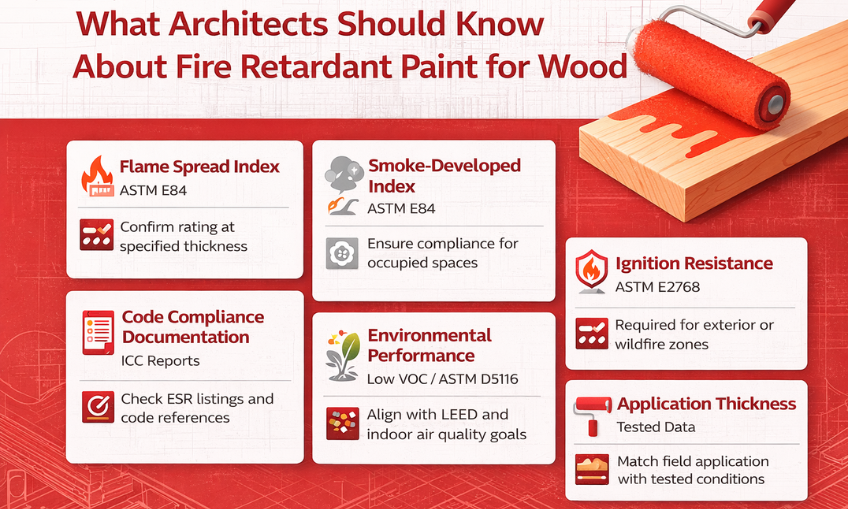
What Should Architects Know About Fire Retardant Paint for Wood?
| Parameter | Standard / Requirement | What Architects Should Verify |
| Flame Spread Index | ASTM E84 | Confirm rating at specified thickness |
| Smoke-Developed Index | ASTM E84 | Ensure compliance for occupied spaces |
| Ignition Resistance | ASTM E2768 | Required for exterior or wildfire zones |
| Code Compliance Documentation | ICC Evaluation Reports | Check ESR listings and code references |
| Environmental Performance | ASTM D5116 / Low VOC criteria | Align with LEED and indoor air quality goals |
| Application Thickness | Manufacturer test data | Match the field application with the tested conditions |
What Should Architects Ask Before Approving Fire Retardant Wood Paints?
Architects should request detailed technical submittals before approval. Major questions include:
-
- What ASTM standards does the paint meet?
-
- What thickness was used during testing?
-
- Does the product have ICC evaluation reports?
-
- How does it perform under extended fire exposure?
-
- What maintenance is required over time?
Fire retardant wood paint manufacturers must provide transparent, verifiable answers. Vague claims should not influence specification decisions.
Final Thoughts for Architects on Fire Retardant Paint for Wood
Fire retardant paint for wood lets architects use exposed wood while maintaining fire safety. These coatings are tested in accordance with ASTM standards, ICC evaluations, and local building codes. They help wood meet fire performance requirements for both interior and exterior applications. With proper selection and verification, architects can balance design, occupant safety, and code compliance.
At Firefree Coatings, our Firefree Class A paint meets ASTM E84, including the 30-minute extended test, and provides ASTM E2768 ignition resistance at a minimal dry film thickness. We provide CAD files, technical documents, and certified test data to help architects include fire protection in their plans. Contact us today to make your wood designs fire-safe!