
Fire safety remains one of the most critical concerns in modern building design. Therefore, understanding how materials behave in fire is essential. ASTM E84, published by ASTM International, is a standardized test method that evaluates the surface burning characteristics of building materials such as intumescent retardant paints and other materials used in walls and ceilings.
By measuring the Flame Spread Index (FSI) and Smoke Developed Index (SDI), this test classifies materials into three safety categories: Class A, B, or C. For architects and builders, understanding these ratings ensures that the materials used in interior finishes comply with code requirements and enhance occupant safety.
“Safety in buildings starts with knowing how materials behave in fire.”
What Is ASTM E84?
ASTM E84, often called the Steiner Tunnel test, is a method for measuring the flame spread and smoke density of building materials. The test involves a 24-foot-long horizontal tunnel in which a sample material is exposed to a controlled gas flame for 10 minutes. Throughout this time, two major metrics are recorded:
Flame Spread Index (FSI): The Flame Spread Index (FSI) is a numerical value that indicates how quickly fire travels across the surface of a material. A lower FSI indicates slower fire spread and higher fire safety.
Smoke Developed Index (SDI): A dimensionless number that measures the concentration of smoke a material emits during burning. For most construction applications, building codes require that wall and ceiling finishes have an SDI of no more than 450.
Note: The combination of these indices allows materials to be classified and used in compliance with local building codes, ensuring safer interior environments.
ASTM E84 Classifications: What They Mean for Fire Safety and Building Materials
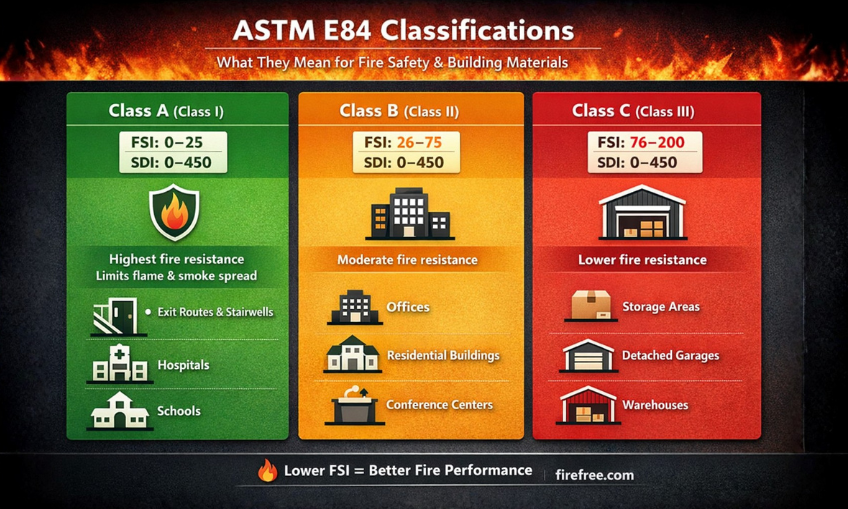
As a builder or architect, when you understand ASTM E84 fire rating classifications, it means taking one step to protect occupants from the devastating effects of a fire. These classifications enable accurate material specifications that meet fire safety standards, comply with building codes, and help reduce fire risks in both residential and commercial projects. Three main flame-spread classifications result from the ASTM E84 test, each based on specific ranges of flame-spread and smoke-developed index values.
Also read, “How Does Fire Retardant Coating (Class A – ASTM E84) Work?”
Class A (Class I): FSI (0-25) & SDI (0-450)
Class A materials provide the highest level of fire resistance. They significantly limit flame spread and smoke production, making them ideal for:
- Exit routes and stairwells
- Hospitals
- Schools
These materials are commonly required in areas with strict fire code requirements and are ideal for enhancing building safety.
Class B (Class II): FSI (26-75) & SDI (0-450)
Class B materials provide moderate fire resistance and are suitable for:
- Offices
- Residential buildings
- Conference centers
They offer a balance between cost and fire performance, making them widely used in standard applications.
Class C (Class III): FSI (76-200) & SDI (0-450)
Class C materials provide lower fire resistance and are generally used in:
- Storage areas
- Detached garages
- Warehouses
These materials are more economical but should be used where fire risk is minimal.
Class A, B, and C Material Classifications
| Class A Materials | Class B Materials | Class C Materials |
| Fire-retardant-treated wood products | Certain types of untreated wood products | Certain types of untreated wood products |
| Cement board | Polyurethane insulation with fire retardants | Certain plastics and composite panels |
| Brick and masonry | Treated acoustical ceiling tiles | Foam panels without protective coatings |
| Gypsum wallboard | Phenolic foam boards | Particleboard |
What Are the ASTM E84 Certification Requirements?
ASTM E84 compliance requirements are referenced in multiple sections of building codes, depending on the material and application. For example, some exterior wall products may require certification under sections such as 1703.5 of the International Building Code (IBC), depending on jurisdiction. Similarly, materials like fire-retardant-treated wood and foam plastics are covered under Chapters 23 and 26, where certification by an approved agency is required.
When it comes to interior finishes, the rules are slightly different. These materials may not always require third-party certification, but they must still meet ASTM E84 test requirements as specified by applicable codes. That said, many manufacturers choose to get their products certified anyway. Doing so makes approvals easier and shows adherence to strong quality control practices, giving builders and buyers added confidence in their products.

What Are the Related Standards to ASTM E84 Standards?
- ASTM E84, UL 723, and NFPA 255 all use the same testing equipment and follow a very similar method. In practice, they are considered equivalent and are often used interchangeably within building codes.
- ASTM E2768 is a related method, sometimes called the 30-minute tunnel test. It is commonly used for testing fire-retardant-treated wood products.
- CAN/ULC S102 also uses similar equipment but follows a slightly different setup and procedure. It is the standard used to evaluate building materials in Canada.
What Are the Limitations of ASTM E84 Standards?
While ASTM E84 is an important test for surface burning characteristics, it has limitations:
- It does not measure heat transmission or overall fire resistance. For complete fire protection, ASTM E119 or similar standards are used.
- It is primarily a surface test, meaning the results apply only to the material’s outermost layer.
Understanding these limitations is really important for architects and builders to ensure complete fire protection. ASTM E84 should be used alongside other fire safety standards (such as ASTM E119) for a complete assessment of fire performance.
Why Fire Rating Classification Matters in Building Applications?
Selecting materials with the correct flame spread rating is not just about meeting code requirements. It directly affects how safely people can exit a building in the event of a fire. It also matters for insurance, as using the wrong materials can create problems with claims. Not meeting the International Building Code (IBC) may delay approvals or require design changes. For example, using a lower-rated material in a space that requires a higher rating can affect occupancy approval, even if the rest of the building is compliant.
Final Thoughts for Architects and Builders on ASTM E84
ASTM E84 provides architects and builders with a clear way to evaluate how materials behave in fire. By understanding flame spread and smoke development, professionals can select safer materials, meet code requirements, and reduce risk. Choosing tested and validated materials, such as intumescent coatings, supports compliant and predictable fire performance.
At Firefree Coatings, we work with architects and builders to select materials that meet fire safety requirements without limiting design flexibility. Our intumescent retardant paint and protective coatings are tested to ASTM E84 standards, ensuring reliable performance in controlling flame spread and smoke development.
Frequently Asked Questions
What Is the Flame Spread Rate?
Flame spread rate indicates how quickly a flame travels across a material’s surface. It is a major factor in assessing fire risk in building materials for both residential and commercial applications.
What Is the Hour Rating of ASTM E84?
ASTM E84 does not provide an hour-based fire resistance rating. It measures flame spread and smoke development, not how long a material can resist fire.
Does PVC Meet ASTM E84?
Standard PVC may not meet flame spread and smoke requirements for plenum applications unless specially formulated or tested.