
Mass timber is appearing more often in architectural projects, especially in WUI (Wildland-Urban Interface) zones. However, it behaves differently from steel or concrete. Even though it performs predictably under fire through charring, it is still treated as a combustible material under the International Building Code (IBC), ASTM, and NFPA standards.
For architects, the main challenge is not whether mass timber can be used, but how fire protection systems are planned around it. This becomes more important when timber is exposed and not fully encapsulated. In this blog, we discuss the important role of wood species selection, the use of fire-retardant coatings, and how these systems work together.
Why Fire Protection Systems Are Important for Mass Timber Buildings
In mass timber projects, fire protection systems cannot be considered for later stages. If you wait until construction documents or site execution, you usually end up adjusting either the structure or the aesthetics. That is where most coordination problems happen.
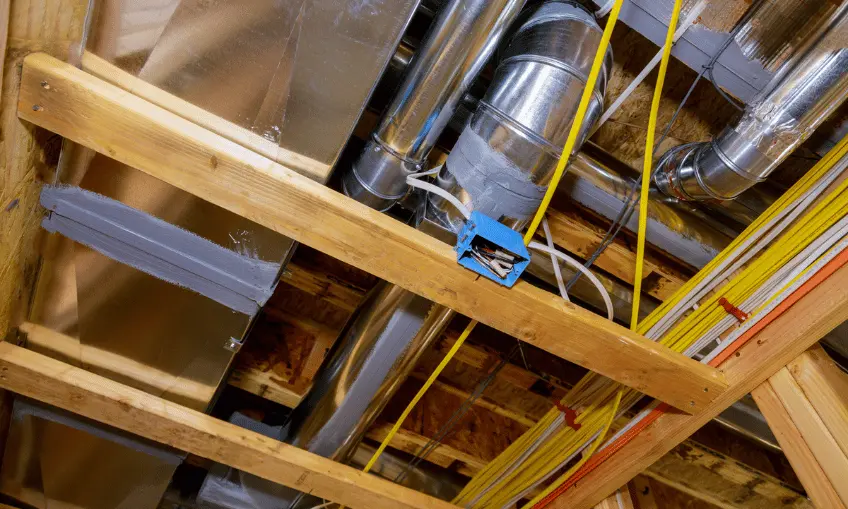
In practice, sprinkler routing often clashes with CLT beam layouts, especially in open-ceiling designs, so early coordination is critical. Early coordination with fire protection engineers helps ensure the layout meets NFPA 13 requirements for proper sprinkler coverage and placement, avoiding conflicts during later stages.
At this stage, you can also decide where services can run through timber elements or where concealed chases are needed inside CLT or DLT panels. At this point, architects generally decide whether exposed ceilings are realistic or require partial concealment.
If fire-resistant coatings or paint are required, this is also the stage at which they should be introduced into the specification, not later when detailing becomes fixed. These paints should be ASTM-tested and comply with ASTM E84 for flame-spread performance. In modern timber design, these coatings are considered part of a broader passive fire protection for timber frames system, rather than just a finish.
In some cases, they may also support fire resistance strategies aligned with ASTM E119. They must also meet relevant NFPA requirements based on occupancy and exposure conditions. The coating is not treated as a finish option. It becomes part of the passive fire-protection system for the mass-timber assembly.
Fire Resistance vs Flame Spread Index (FSI) in Timber
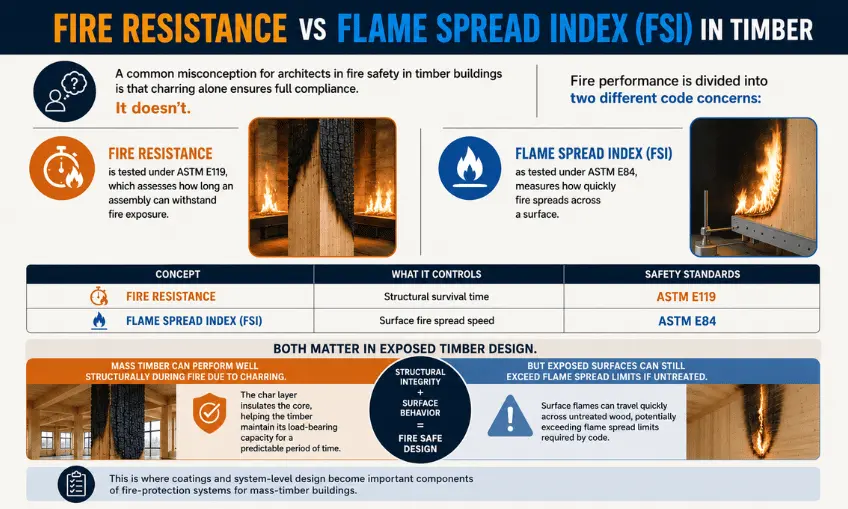
A common misconception for architects in fire safety in timber buildings is that charring alone ensures full compliance. It doesn’t. Fire performance is divided into two different code concerns:
- Fire resistance is tested under ASTM E119, which assesses how long an assembly can withstand fire exposure.
- The Flame Spread Index (FSI), as tested under ASTM E84, measures how quickly fire spreads across a surface.
| Concept | What It Controls | Safety Standards |
| Fire resistance | Structural survival time | ASTM E119 |
| Flame spread index | Surface fire spread speed | ASTM E84 |
Both matter in exposed timber design. Mass timber can perform well structurally during fire due to charring, but exposed surfaces can still exceed flame spread limits if untreated. This is where coatings and system-level design become important components of fire-protection systems for mass-timber buildings.
What Is the Role of Wood Species Selection in Fire Safety?
Wood species selection is not only a structural decision but also influences timber structure fire risk assessment outcomes. Different species have different flame-spread index values, which can affect whether additional treatment is needed to meet code requirements. For example, hardwoods like maple generally perform better in flame-spread testing than many softwoods.
This is relevant when timber is exposed and must comply with ASTM E84. When architects coordinate with suppliers and structural engineers, it can reduce the extent of fire protection coatings required later. This also reduces the risk of design changes during approval stages and improves predictability in fire safety for timber buildings.
Also Read: Fire Retardant Paint for Wood: A 2026 Architect’s Guide
How Fire Retardant Paint for Wood Helps in Timber Buildings?
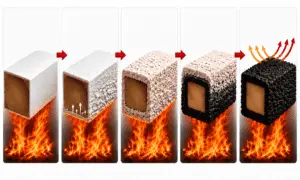
Fire protection paint is often used where architects want to keep timber exposed but still meet fire performance requirements. Intumescent coatings expand when exposed to heat and form a protective insulating layer over the timber surface.
When applied correctly, intumescent coatings delay surface ignition long enough to meet code-required evacuation times. They are especially useful in exposed beams, ceilings, and atrium-facing surfaces where encapsulation is not desired.
Key Takeaways on Fire Protection Systems for Mass Timber Buildings
Fire safety in mass timber buildings works best when it’s planned from the very beginning, not added later. Even though timber chars in a predictable way, it still needs to meet key safety standards for fire resistance and flame spread. A well-coordinated mix of design, sprinklers, coatings, and material choices helps keep buildings safe while still achieving the desired architectural look.
At Firefree Coatings, we offer fire-retardant paint for wood to improve fire safety in mass timber buildings. Our product meets ASTM E84 standards, including the 30-minute extended test, and helps reduce flame spread on combustible surfaces. For architects, it provides a practical solution to help enhance fire safety for timber buildings and support safer, code-compliant building designs.