
How Do Intumescent Coatings Protect Structural Steel? (A Guide)
Steel is known for its strength, but during a fire, that strength can disappear far faster than many expect. Under major fire conditions, unprotected structural steel can reach critical temperatures within minutes, leading to deformation or collapse. This poses serious risks to occupants, firefighters, and property.
Intumescent coatings for steel are widely regarded as one of the most effective fire protection solutions. These fire resistant coatings are specially designed to react when exposed to high heat. In this blog, we will discuss how intumescent paint for steel can protect your property’s steel structures.
Why Structural Steel Needs Fire Protection
Steel does not burn, but it weakens rapidly when heated. At around 400°C, steel begins to lose strength. By 500-600°C, it can lose more than half of its load-bearing capacity. In a typical building fire, these temperatures can be reached in less than 15 minutes. Without protection, steel beams and columns can bend, twist, or collapse.
This can cause floors to fail and entire structures to fall. Intumescent paint is one of the most widely used solutions because it is efficient, lightweight, and visually appealing. Common fire ratings of the paints include 60, 90, and 120 minutes. This time is crucial for safe evacuation and effective firefighting operations.
What Are Intumescent Coatings for Steel?
Intumescent coatings are reactive fire-resistant coatings applied directly to steel surfaces. As one of the most widely used fire retardant coatings for structural steel, they appear like ordinary paint under normal conditions. When exposed to high temperatures, usually above 200–250°C, the coating undergoes a chemical reaction that causes it to swell dramatically. It can expand up to 20 to 50 times its original thickness. The result is a thick, foamed carbon char that insulates the steel from heat.Intumescent coatings are reactive fire-resistant coatings applied directly to steel surfaces. As one of the most widely used fire retardant coatings for structural steel, they appear like ordinary paint under normal conditions. When exposed to high temperatures, usually above 200–250°C, the coating undergoes a chemical reaction that causes it to swell dramatically. It can expand up to 20 to 50 times its original thickness. The result is a thick, foamed carbon char that insulates the steel from heat.
How Intumescent Paint for Steel Works
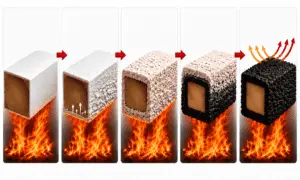
Intumescent paint works through a controlled chemical process called the intumescent reaction. This process happens in several clear stages.
- Heat Exposure: When fire breaks out, the temperature around the steel rises rapidly. Once the coating reaches approximately 200°C, it starts to activate.
- Chemical Activation: At its core, the coating relies on three basic ingredients:
- Acid source, such as ammonium polyphosphate
- Blowing agent, such as melamine
- Carbon source, such as starch or pentaerythritol
The acid source decomposes under heat. The blowing agent releases non-flammable gases, such as water vapor, ammonia, and carbon dioxide. At the same time, the carbon source reacts to form a char.
- Swelling and Foaming: The released gases get trapped within the softened binder of the coating. This causes the paint to swell rapidly. The coating transforms into a thick, foamy layer filled with tiny air pockets.
- Formation of an Insulating Char: The expanded char has very low thermal conductivity. It acts as a thermal shield. Heat from the fire takes much longer to reach the steel surface.
- Protection of Structural Steel: Because heat transfer is slowed down, the steel temperature rises gradually. This keeps the steel below its critical temperature for a longer time. Steel structural strength is maintained, and collapse is delayed.
Properties of Intumescent Coatings for Steel
Intumescent coatings offer several practical advantages, such as:
- They do not change the mechanical properties of steel.
- They are lighter than fire boards or concrete encasements.
- They can be applied to steel, composite columns, and concrete surfaces.
- They dry quickly, often within one hour under normal conditions.
- They can be applied to both new steel and previously coated steel using suitable primers.
- They provide a smooth and aesthetic finish, ideal for exposed steel structures.
These properties make intumescent paint for steel a preferred choice in commercial, industrial, and residential projects.
How to Apply Intumescent Coatings for Steel
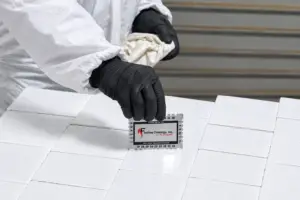
Applying intumescent coatings is a controlled process. This includes:
- Prepare the steel structure surface. Steel must be clean, dry, and free from oil, dust, or rust.
- Use the primers to ensure proper adhesion and corrosion protection.
- The intumescent coating is then applied using spray, roller, or brush methods.
- After that, maintaining thickness control is important, as fire performance depends on the correct dry-film thickness.
Where Intumescent Coatings for Steel Are Used
Intumescent fire protection systems are widely used in many sectors. These include:
- Commercial buildings
- Airports and railway stations
- Shopping malls
- Industrial plants
- Warehouses
- Data centers
- Residential high-rise buildings
Advantages of Intumescent Coatings Over Other Fire Protection Methods
Compared to traditional fireproofing methods, intumescent coatings offer clear benefits. This includes:
- They take up less space.
- They add minimal weight to the structure.
- They allow designers to showcase steel elements.
- They are easier to maintain.
Advanced Fire Safety with Intumescent Coatings: Key Takeaways
Intumescent coatings play an important role in protecting structural steel during a fire. They react intelligently to heat, expanding into a thick insulating char that shields steel from extreme temperatures. This reaction slows down heat transfer and prevents steel from reaching its critical temperature too quickly.
At Firefree Coatings, we provide low-VOC intumescent coatings for steel. Our fire resistant coatings give people time to escape and keep the steel structure strong in the event of a fire. Contact us today!